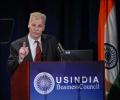
Ron Somers, president, US-India Business Council, which lobbied to get the US-India nuclear technology deal approved, like the rest of the American business fraternity, is upset by India's recent purchase of nuclear reactors and sophisticated technology and weaponry from Russia.

Harold 'Terry' McGraw, chairman, president and chief executive officer, McGraw-Hill companies, has taken over the helm of the United States-India Business Council, succeeding Indra Nooyi, chairman and CEO, PepsiCo.

The former President also predicted that the conflict between India and Pakistan would be resolved by people power where "the people are going to force the nations to work for the prosperity of the nation and the peace of the nation."

Interview with strategic analyst C Raja Mohan on the recent Nuclear Summit in the US
Leading South Asia analysts in the United States have slammed President Obama for his stout defense of Islamabad as committed to non-proliferation and a safe steward of its nuclear weapons arsenal, and described his comparing the safety and security of US and Pakistan nuclear weapons is "unhelpful and disingenuous".
Prime Minister Manmohan Singh, during his interaction with the press after the conclusion of the Nuclear Security Summit in Washington, delivered some short, crisp answers on a host of issues.When he was informed that Pakistani Prime Minister Yousaf Raza Gilani had told the press that he had invited the PM to Islamabad and the latter had accepted the invitation, Dr Singh quipped to much laughter, "I am hearing it for the first time."
Speaking on the IPL controversy involving Minister of State for External Affairs Shashi Tharoor, Prime Minister Manmohan Singh on Tuesday said that he had to ascertain all the facts after he returned to India on April 17, before taking any action in the matter.When he was asked if Tharoor would be sacked over the Kochi IPL team controversy, the PM said, "I have heard about these things. I don't have all the facts before me and when I go back, I will get all the facts."
Prime Minister Manmohan Singh on Tuesday said India could resume its dialogue with Pakistan on all issues if 'concrete and effective' action is taken against the perpetrators of the terror strike on Mumbai, but made it clear that there was no need for the United States or any other country to get involved in Indo-Pak affairs. Dr Singh expressed his dissatisfaction over insufficient action taken by Pakistan against the masterminds of 26/11.
Prime Minister Manmohan Singh has dismissed concerns among leading analysts, both in India and the United States, that Indo-US ties under the aegis of President Barack Obama and his administration cannot compare to the bonhomie and rapport he and New Delhi enjoyed with President George W Bush and his administration."I have a very good relationship with President Obama. So I think there should be no confusion on that point," he stated at a press interaction.

Pakistan Prime Minister Yousaf Raza Gilani, who had arrived 10 minutes earlier than Prime Minister Manmohan Singh, on seeing the latter, scooted over, greeted him with a firm handshake and could be seen exchanging pleasantries.After Obama welcomed the last guest at 6.30 pm, all the leaders moved into another cavernous room in the Convention Centre for the dinner that was closed to the press.
"Al Qaeda is especially notable for its longstanding interest in weapons-usable nuclear material and the requisite expertise that would allow it to develop a yield-producing improvised nuclear device," said John Brennan, the Deputy National Security Advisor for Counter-terrorism and Homeland Security, on Monday.

Senior American administration and diplomatic sources who sat in on the 50-minute mini-bilateral summit between President Barack Obama and Indian Prime Minister Dr Manmohan Singh, spoke animatedly how the "atmospherics were excellent," and what "a delight it was to watch the substantive interactions between these two extremely cerebral individuals".
Well briefed on India's angst over the ambiguity on the access to Lashkar operative and 26/11 conspirator David Coleman Headley and also the perceived US indifference to India's role in Afghanistan, US President Barack Obama has assured Prime Minister Manmohan Singh that he was "fully supportive" of India's request for access to Headley and "fully appreciated" and "recognized the enormous sacrifices" India has made in helping "stabilize" Afghanistan.

It's been full circle for Gautam Adhikari, erstwhile Washington bureau chief of the Times of India, who returns to the US capital and the think tank circuit as a visiting fellow at the East-West Center for a year-long residency co-sponsored by the Federation of Indian Chambers of Commerce and Industry, reports Aziz Haniffa.
United States President Obama will host Prime Minister Manmohan Singh in a mini bilateral summit before the start of the Nuclear Security Summit in Washington beginning April 12, instead of the brief meeting originally slated on the margins of the parley, claim sources. The report about the possible meeting comes amidst growing concern in both the US and New Delhi that the Obama administration has been ignoring India.
US President Barack Obama has appointed an Indian American, Srinija Srinivasan, to his 13-member Commission on Presidential Scholars.
The 'trust deficit' between the United States and Pakistan has seemingly evaporated after the strategic dialogue between Washington and Islamabad in March, that also featured Army chief General Ashfaq Kayani and Inter Services Intelligence director general Shujat Ahmad Pasha.If the remarks of Daniel Benjamin, the State Department's coordinator for counter-terrorism are anything to go by, the US no longer is suspicious of Pakistan playing a double game.
The US believes Lashkar-e-Tayiba, the Pakistan-based terrorist organisation, responsible for the horrific Mumbai terror attacks on 26/11 and several other terrorist acts in India, could soon replace Al Qaeda as the number one worldwide terrorist threat or at the very least compete with Osama bin Laden's global Terror Inc.
Ambassador Daniel Benjamin, coordinator for counter-terrorism at the United States department of state, has made it abundantly clear that his office will not influence law enforcement authorities via any diplomatic lobbying to provide India with direct access to Lashkar-e-Tayiba operative David Coleman Headley. Pakistani-American Headley was part of the conspiracy for the horrific terror attacks that shook Mumbai on November 26, 2008 and left 166 people dead.
US has said that it is yet to take a decision on Lashkar operative David Coleman Headley's extradition to India, said Robert Blake, the Obama Administration's point man for South Asia, especially India-Pakistan relations.
